
The idea for this article started with a conversation about an old Alistair MacLean novel.
Athabasca was published in 1980. The story moves between the oil industry in Alaska and the Athabasca oil sands in Alberta, Canada. A typical Maclean thriller, where sabotage and murder feel less like events and more like characters than events.
That got us wondering.
What was actually happening in the Athabasca oil sands around the time MacLean wrote the book?
And how is the oil produced there today?
We started looking.
Before long, we had ended up more than 200 metres underground with a chemical engineer called Roger Butler and two horizontal wells.
Not quite where we expected to go.
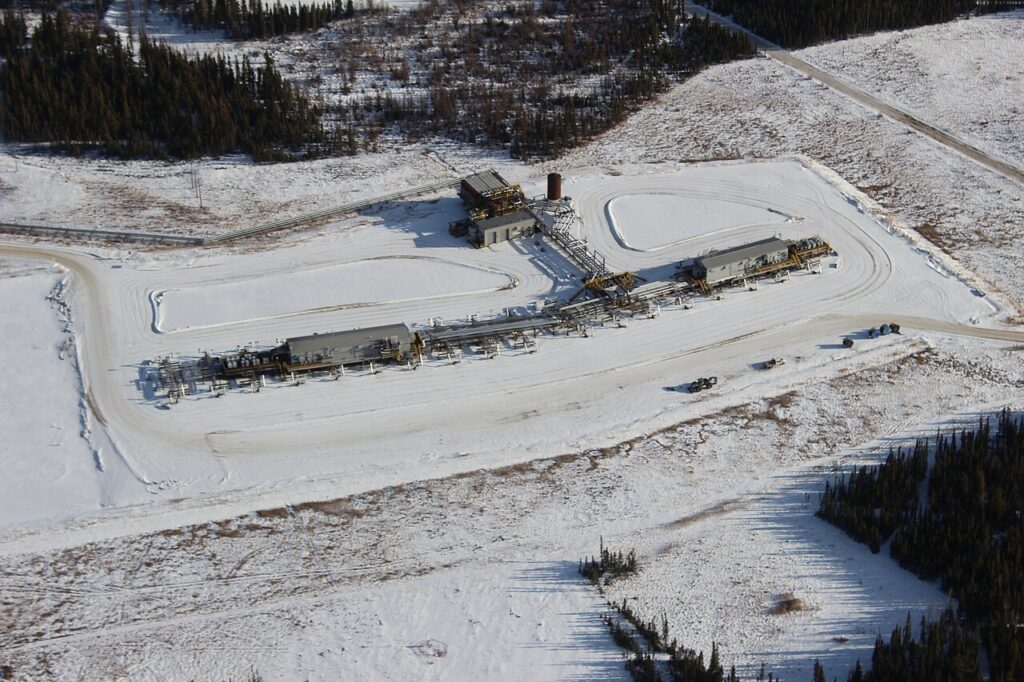
First, what exactly are the Athabasca oil sands?
The Athabasca oil sands cover a huge area of northeastern Alberta, around Fort McMurray.
And when people talk about oil sands, the images we tend to see are enormous open-pit mines. Huge trucks. Excavators. Sand being dug up and taken away for processing.
So it is easy to assume that this is how the oil sands work.
Dig up the sand. Extract the bitumen.
Except most of the resource cannot be reached that way.
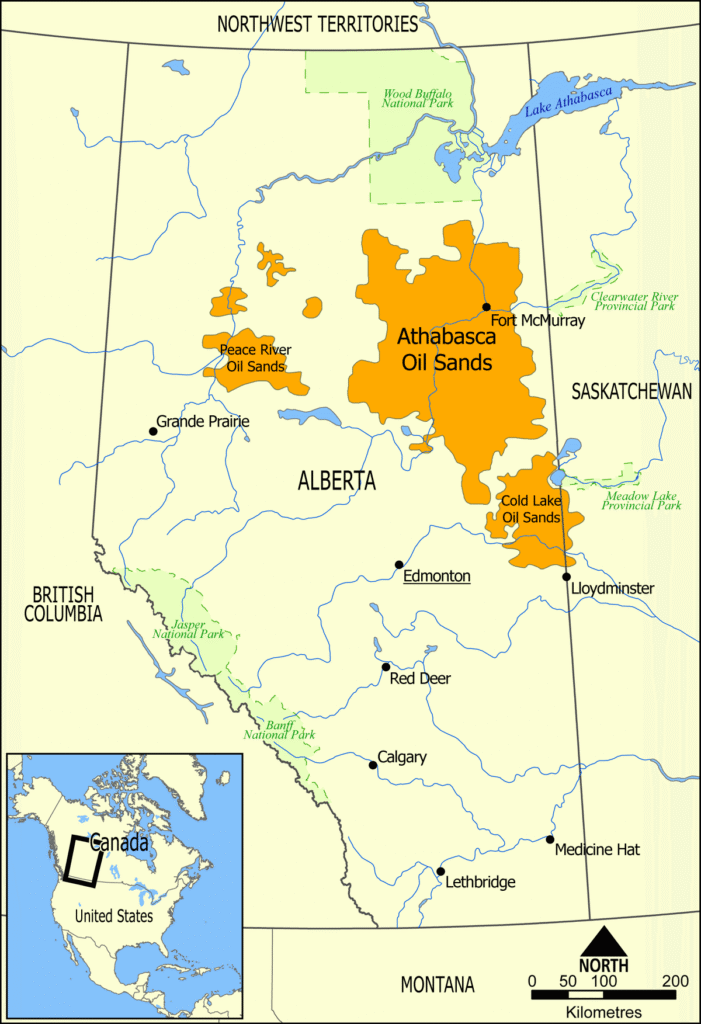
Natural Resources Canada says about 80% of Canada’s oil sands reserves are accessible only through in-situ methods because the deposits are too deep for open-pit mining.
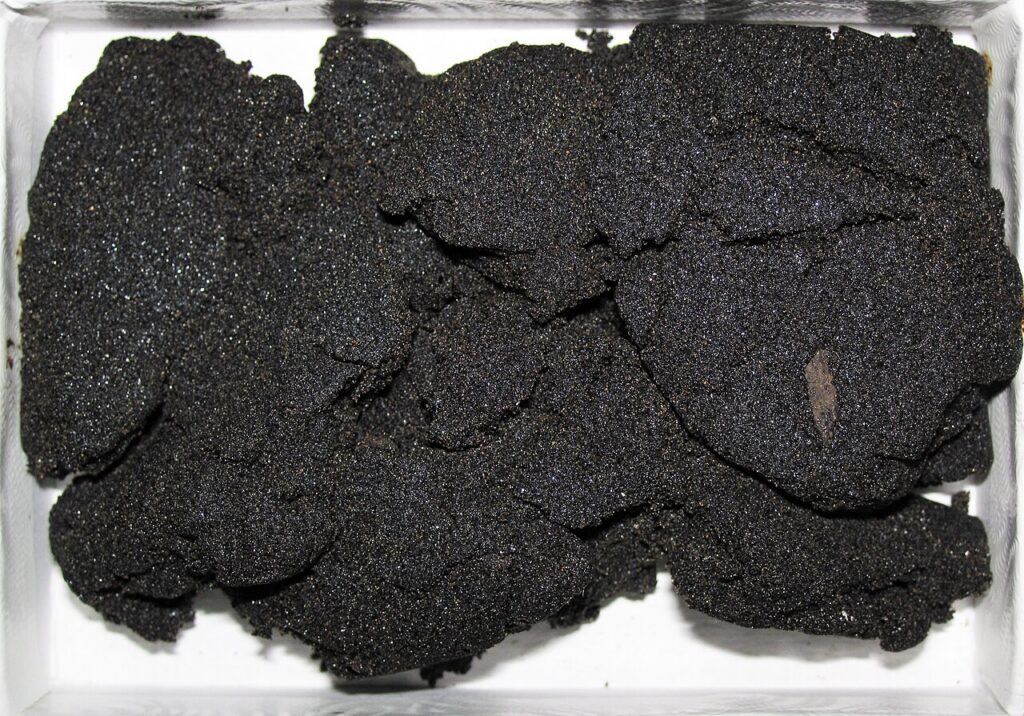
So now there is another problem.
The bitumen is underground.
And it doesn’t flow particularly well.
Bitumen is extremely viscous. Heat it, though, and it becomes much easier to move.
Engineers had already been experimenting with steam as a way of doing that.
Then Roger Butler started thinking about gravity.
Roger Butler’s idea
Butler was a chemical engineer who moved from Britain to Canada in the early 1950s.
He worked for Imperial Oil and eventually led research into heavy oil.
In 1969, he patented a gravity-drainage concept. During the 1970s, he began looking at another possibility: instead of relying on conventional vertical wells, perhaps horizontal wells could be used to recover heated bitumen.
The basic idea is not too difficult to picture.
Heat the bitumen.
It becomes more mobile.
Gravity pulls it down.
So put a production well underneath it.
Eventually, Butler’s system involved two horizontal wells, running roughly parallel to each other.
Steam would be injected through the upper well.
The heated bitumen would drain towards the lower well.
The lower well would collect it.
Today we know the process as Steam-Assisted Gravity Drainage, or SAGD.
But in the 1970s, it was still an idea that had to prove itself.
The first attempt wasn’t enough
Imperial Oil tested an early form of Butler’s approach at Cold Lake in 1978. The experiment paired a horizontal production well with a vertical steam-injection well.
Imperial decided that the system wasn’t particularly suitable for the Clearwater reservoir there and continued using another steam-based technique instead.
So SAGD didn’t suddenly take over the industry.
Butler later took early retirement from Imperial and joined AOSTRA — the Alberta Oil Sands Technology and Research Authority.
AOSTRA was working on something rather unusual.
An underground research facility north of Fort McMurray.
Butler suggested testing SAGD there.
Then they went underground
The Underground Test Facility opened in 1987, about 60 kilometres north of Fort McMurray.
Two shafts were drilled more than 200 metres into the ground.
The drill bit used to sink them was almost four metres across and weighed about 230 tonnes.
There is another number worth looking at.
After drilling more than 200 metres down, neither shaft was more than 2.5 centimetres away from vertical. That’s not much room for error.
At the bottom, tunnels were constructed in the rock beneath the oil sands.
From there, researchers could drill upwards into the reservoir and experiment with different ways of recovering the bitumen.
And this was where Butler’s two-well idea finally got a proper trial.
Three pairs of wells
The first SAGD experiment at the facility used three pairs of horizontal wells. Each pair was about 70 metres long.
Steam went into the upper well. Then they watched what happened.
After about a year, it was clear that the process was working.
AOSTRA had expected recovery of somewhere around 30% to 45% of the bitumen in the test area. Eventually, recovery reached about 65%.
That got people’s attention.
AOSTRA had initially struggled to attract much industry support for the Underground Test Facility. Once the early experiments began producing results, ten companies contributed to the next phase.
The two-well idea worked, but there was still an obvious problem.
You couldn’t build underground tunnels everywhere.
The tunnels weren’t really the point
What mattered was being able to position two horizontal wells close together inside the reservoir.
Eventually, drilling technology became precise enough to do that from the surface.
Alberta’s history of Butler’s work notes that computer-controlled drilling allowed parallel horizontal wells to be positioned within about five metres of one another.
Now the tunnels were no longer necessary.
And this is probably the point where a diagram makes more sense than another few paragraphs.
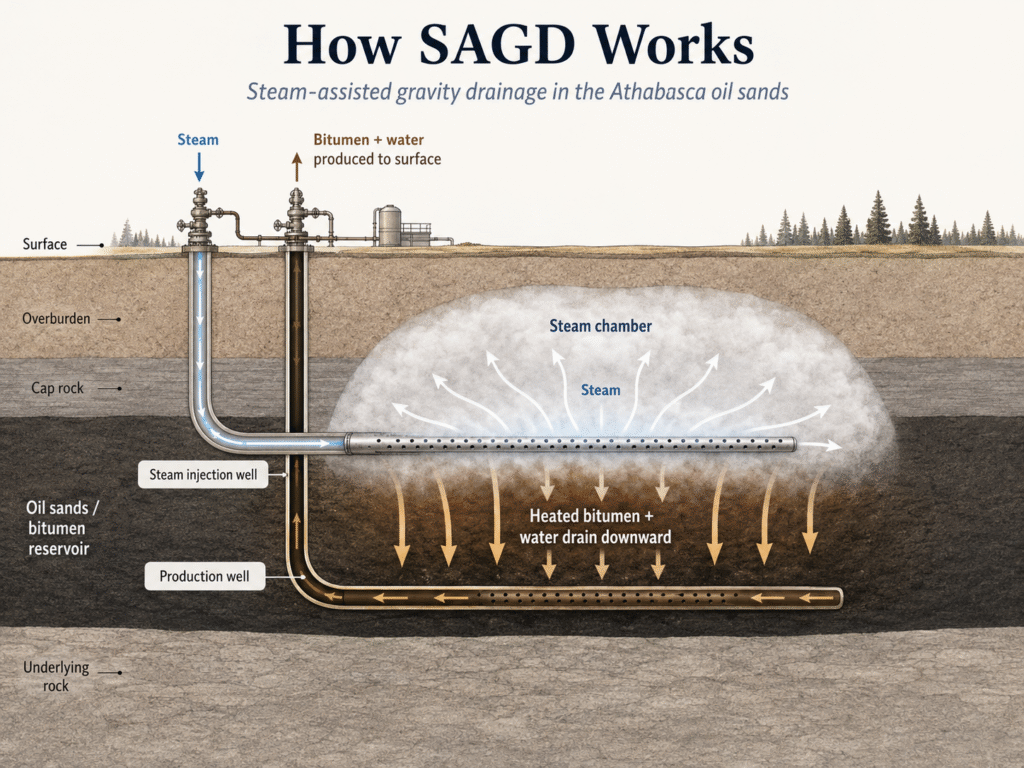
The arrangement is fairly simple to understand. Two horizontal wells, one above the other.
Steam is continuously injected into the upper well. As the reservoir heats, a steam chamber develops.
The bitumen becomes less viscous and drains downwards with the condensed water.
The lower well collects them and brings them to the surface.
Natural Resources Canada now describes SAGD as the most widely used in-situ recovery method in Canada’s oil sands.
And then we looked at the dates again
This was the part that brought us back to Athabasca.
MacLean’s novel was published in 1980.
Butler’s Cold Lake experiment had happened only two years earlier.
The Underground Test Facility wouldn’t open until 1987.
By the 1990s, the experiments had worked.
And today, SAGD is a normal part of the Canadian oil-sands industry.
So when Athabasca was being written, the technology that would later become Canada’s most widely used method for producing deeper oil sands had not yet been successfully demonstrated at the facility that helped prove it.
The story doesn’t end there.
Producing all that steam requires energy and water. Natural Resources Canada notes that thermal bitumen extraction is more energy intensive than conventional crude-oil production because of the energy needed to generate steam, and reducing water use and emissions remains an important part of ongoing work.
So SAGD didn’t somehow solve every problem associated with oil-sands production.
That wasn’t really the question we started with anyway.
We started with an old thriller and a place called Athabasca.
Then we tried to find out how people actually get oil out of the ground there.
Somewhere along the way, we found Roger Butler, two 200-metre shafts, an underground laboratory and three pairs of horizontal wells.
It turned out to be a much more interesting story than we expected.
Sources and further reading
- Natural Resources Canada — Oil Sands Extraction and Processing. Overview of open-pit and in-situ oil-sands production, including SAGD.
- Alberta's Energy Heritage — Roger Butler and In Situ Development. Background on Roger Butler, the 1969 gravity-drainage concept, the 1978 Cold Lake test and the development of SAGD.
- Alberta's Energy Heritage — Underground Test Facility. History of the AOSTRA facility and the early SAGD experiments.
- Natural Resources Canada — Frequently Asked Questions about Direct Contact Steam Generation. Background on the energy and water requirements of thermal oil-sands recovery.
PPS Voices
Join the conversation
Comments are reviewed before publication. Please keep the discussion relevant and respectful.
No comments yet. You can be the first to join in.