
I came across a strange little fact about Ne Zha 2.
There is a moment when Ao Bing sweeps his weapon across the screen and the ink seems to freeze and spread at the same time. It lasts about 0.8 seconds.
The production team spent nine months working on it.
I had to read that again.
Nine months?
Animation is obviously complicated. There are people working on movement, lighting, textures, effects and all sorts of things most of us never think about while watching a film.
But still.
0.8 seconds.
So I started looking into what they had actually been doing.
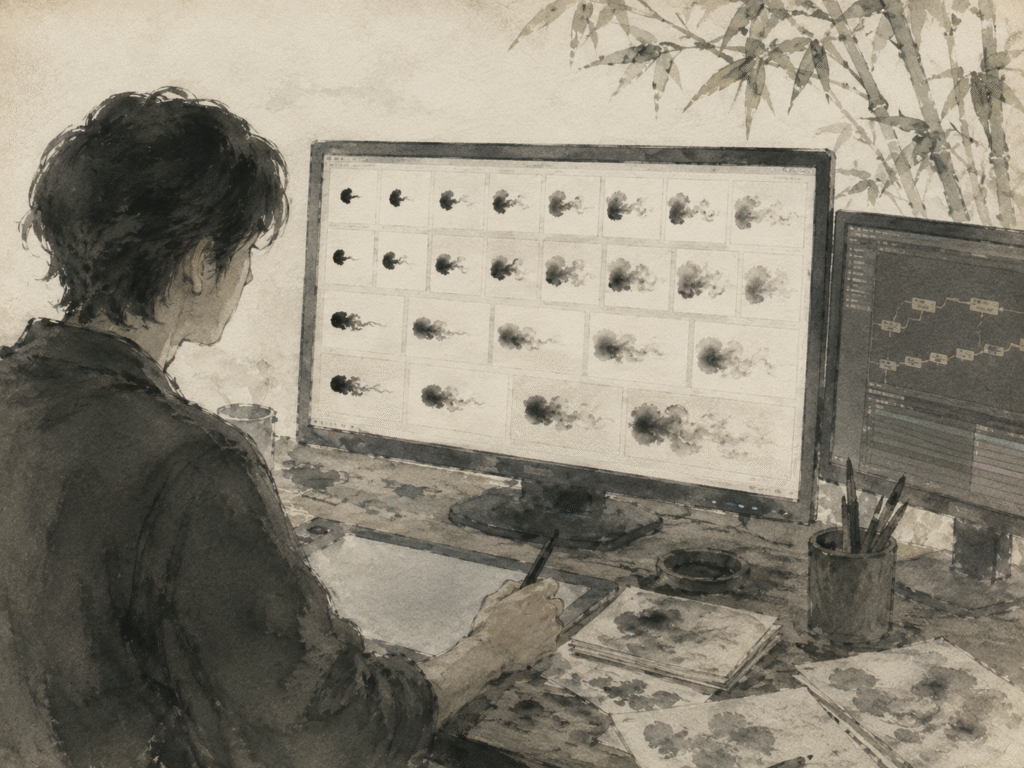
Ink Has Its Own Ideas
At first, I assumed it was mainly a visual-effects problem. Make the edges softer, let the black spread, add the texture of xuan paper and somehow make the whole thing feel less digital.
Obviously, there would be a lot more maths involved than that.
But then I started reading about what actually happens when ink touches paper.
Put a drop of ink onto xuan paper and it immediately starts going somewhere. Water moves into the paper and carries pigment with it. One edge spreads quickly; another barely moves. A dark patch gathers in one place while somewhere else the ink becomes pale enough to almost disappear.
And then there is the paper itself. The fibres underneath are quietly interfering with everything.
Add a little more water and the mark changes. Make the ink slightly thicker and it changes again. Try making exactly the same mark twice and it probably won’t happen.
Which is perfectly fine if you are painting.
Animation is a little less forgiving.
If something is here in one frame, somebody needs to know where it will be in the next. The movement needs to continue. The shape cannot suddenly become something completely different just because the imaginary paper decided to absorb more water this time.
Ink, unfortunately, has not been informed of the schedule.
I found a 2006 paper from researchers at Shanghai University who were already trying to simulate this digitally. They modelled the interaction between water, ink particles and the fibre structure of xuan paper, then used a particle system to recreate the way the ink diffused.
I had been imagining a computer drawing a convincing black mark.
Instead, here were people modelling paper fibres.
That took me rather further into the subject than I had expected.
And Then There Were Tadpoles
Somewhere while reading about digital ink, I came across Where Is Mama? (《小蝌蚪找妈妈》).
It was made by Shanghai Animation Film Studio and released in 1961. For people who grew up in China, it may be immediately familiar. I suspect quite a few English-speaking readers have never heard of it.
The story is wonderfully uncomplicated. A group of tadpoles hatch, discover that their mother is nowhere around and go swimming through a pond asking other animals whether they might be her.
That is more or less the plot.
The film looks far more unusual.
The National Radio and Television Administration describes it as China’s first ink-wash animation and connects its visual language with the paintings of Qi Baishi. The tadpoles do not look like ordinary cartoon characters placed on top of a painted background. They look as though they belong inside the painting.
There is not actually very much on the screen.
A few lotus leaves, plants, rocks, pale water and these little black shapes swimming around.
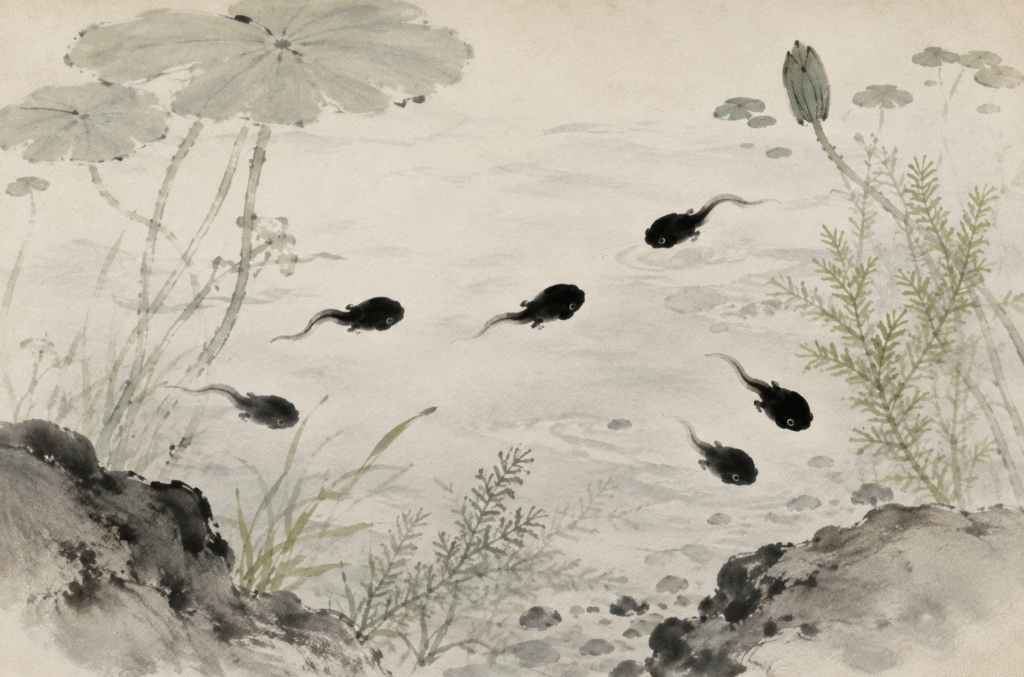
A tadpole seems like it should be easy to draw. There is a dark body, a tail and not much else.
Then it has to swim.
The tail bends. The body turns. Its shape shifts a little as it moves through the water. And somehow, frame after frame, it still has to feel as though it was made with wet ink rather than carefully filled in on a cartoon cel.
I kept looking at the simplicity of it.
Perhaps that was what made it so deceptive.
The same thing happens with the chicks.
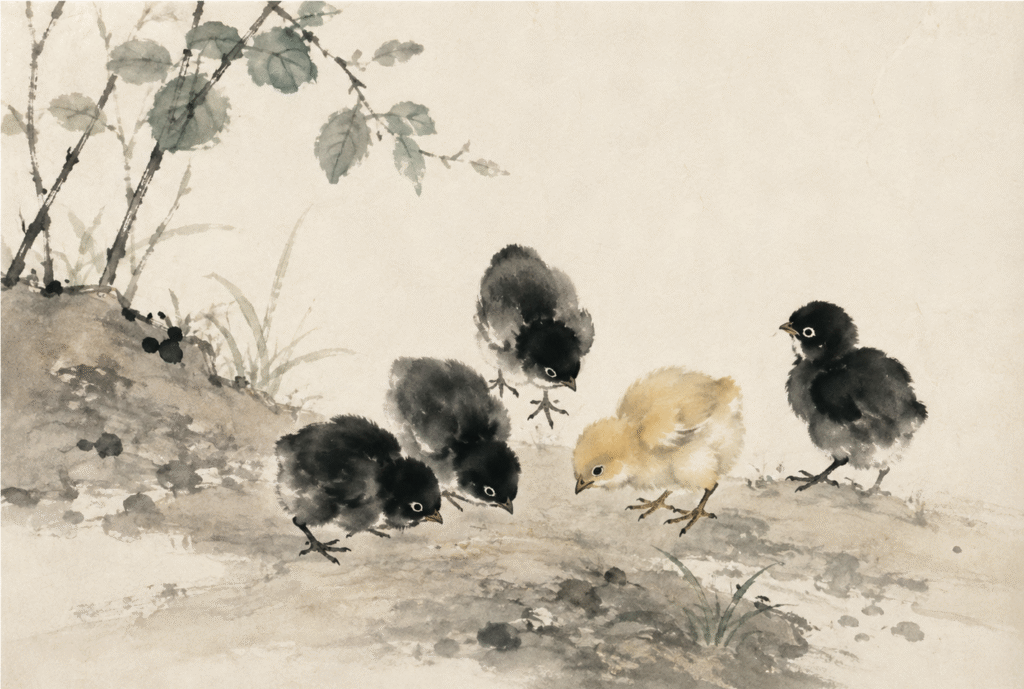
There really isn’t much there. Some dark ink, a few lighter washes, tiny legs, a beak.
Yet one chick looks busy. Another looks as though it has stopped to watch something. One seems slightly more curious than the rest.
Our eyes seem quite willing to do a lot of the work.
Which is nice when the picture stays still.
Someone, however, had decided these things should move.
And this was 1961.
No computers. No particle systems. No rendering engines.
So I wondered how they had done it.
Apparently, Not by Painting It Over and Over Again
I had assumed the obvious answer.
If the finished film looked like an ink painting, perhaps the artists simply painted lots and lots of ink paintings.
They didn’t.
Traditional ink spreads differently each time it touches paper. If you need hundreds of frames to match closely enough to create movement, that becomes rather inconvenient.
The solution was much stranger.
Animator and director Yan Dingxian later described how the studio prepared several different versions of the same image, with different degrees of sharpness and softness. A single tadpole in a single frame might exist as four versions, from clearly defined to increasingly diffuse.
Those versions could then be combined photographically through repeated exposure.
So one frame might require four drawings.
And four exposures.
Then there was another frame.
And another.
The film is about twenty minutes long.
At some point I stopped trying to imagine the number of tadpoles involved.
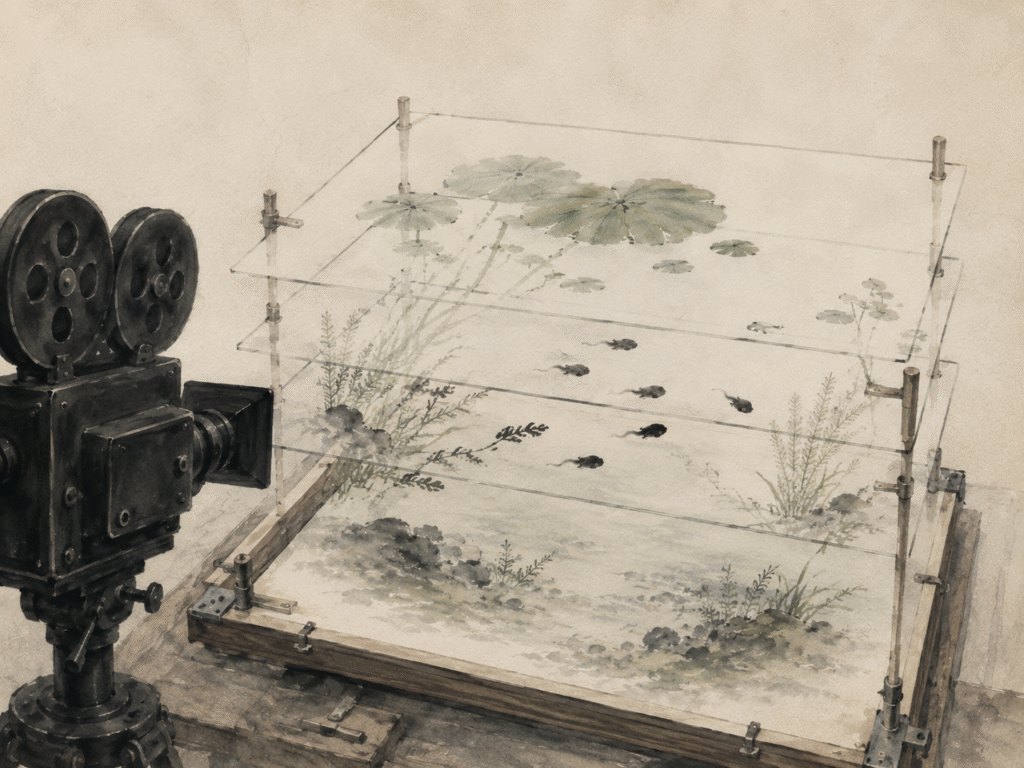
The part I found especially odd was that the soft little tadpole we see in the finished film was not necessarily sitting there, complete, on any single drawing. Its final appearance emerged after those different versions had been photographed together.
Then, once all of that was finished, it simply swam off across the pond.
I went back and watched some of the old animation again.
Knowing how it had been made did not make it look more complicated.
If anything, it looked even simpler.
A few black tadpoles.
Some pale water.
A frog.
They carry on looking for their mother.
I Had Almost Forgotten About Ne Zha 2
By this point, I had wandered quite a long way from the 0.8-second shot that started all of this.
But it was still sitting in my notes.
So I went back.
The tools, obviously, are completely different now. The animators behind Where Is Mama? worked with drawings, cameras and repeated exposure. The people making Ne Zha 2 had 3D animation, digital effects, particle systems and considerably more computing power.
The ink was still causing trouble.
For the brief shot involving Ao Bing, the production team wanted the ink to appear to move between freezing and spreading. Reports on the film say that work on the sequence eventually led to the development of a dynamic ink-wash rendering engine capable of simulating the diffusion of ink on xuan paper.
Nine months.
There it was again.
Except now I also had an animator from the 1960s drawing several versions of one tadpole so that a camera could photograph them repeatedly.
I am not sure which sounds more exhausting.
One involves computers and algorithms.
The other involves an alarming number of drawings of tadpoles.
The Film Moves On
The funny thing is that none of this really announces itself when we watch the finished work.
The tadpoles swim around looking for their mother. Nobody watching them needs to know how many drawings were used to make one frame.
Ao Bing’s weapon crosses the screen. The ink changes. Less than a second later, something else is happening.
The films do not wait for us to appreciate the effort.
They just carry on.
I went back once more to those old tadpoles.
They still looked very simple.
A few black shapes moving through pale water, as though someone had touched a brush to the page and they had quietly decided to swim away.
Which, after reading about everything required to make them do that, is rather funny.
Sources and further reading
- Science and Technology Daily. 技术传递情感 科技赋能国漫
- Liu Weiwei / Xinhua. 小小哪吒,何以“闹翻”巨大的电影市场?
- People’s Daily Arts / National Radio and Television Administration. 中国动画100年,从塑造典型到创造经典
- Gong Danyun / Jiefang Daily. 做引领者,而不是跟风者——独家专访美术电影导演严定宪
- Chen Feng, Zhang Wenjun and Zhang Mu / Journal of Shanghai University (Natural Science Edition). Simulation Model of Ink-Wash Effect Based on a Dynamic Diffusion Mechanism
PPS Voices
Join the conversation
Comments are reviewed before publication. Please keep the discussion relevant and respectful.
No comments yet. You can be the first to join in.