

I had been looking through an old dictionary when I found dord.
There was nothing about the word that deserved immediate suspicion. It sat comfortably among its neighbours, printed in the same confident type, followed by the usual little pieces of information.
dord, n. Physics & Chem. Density.
I pronounced it quietly.
Dord.
It sounded possible.
That counts for rather a lot with an unfamiliar word. Had it been drzxq, I might have been more cautious, but dord had the decency to sound English. I could imagine a physicist using it. I could imagine myself encountering it in an old paper, checking the dictionary and accepting the verdict.
The dictionary, after all, was Webster’s.
I read the entry again. The pronunciation was given. The word was labelled as a noun. Its territory was neatly marked out: physics and chemistry. The definition was uncomplicated.
Then I noticed that its history was missing.
There was no etymology.
This need not have meant very much. Old dictionaries have their peculiarities, and I had no intention of prosecuting every incomplete entry I encountered. Still, dord had begun to interest me. I looked for examples of its use.
That was where the difficulty began.
I could find the dictionary entry easily enough. What I could not find was the world in which the word had lived.
No trail of scientific papers. No old textbook in which a student was instructed to measure the dord of anything. No argument between physicists about dord. For a word supposedly belonging to physics and chemistry, it seemed to have enjoyed an extraordinarily private existence.
I began to wonder whether I had misunderstood the entry.
Then I discovered that somebody at Merriam-Webster had wondered the same thing.
The year was 1939.
The record tells us very little about the editor who took an interest in dord. It does tell us what mattered.
The dictionary had been published five years earlier.
Webster’s New International Dictionary, Second Edition was a formidable object. Around 250 editors and consultants had worked on it. The finished book weighed about seventeen pounds. Thousands of pages held hundreds of thousands of entries, packed into columns so dense that one could spend quite a long time in a very small patch of the alphabet.
Somewhere inside it, dord had been living quietly since 1934.
The editor noticed the missing etymology.
A word without an etymology is not necessarily an impostor, but it gives an editor somewhere to begin. There should have been material behind the entry: citation slips, notes, evidence collected from published use. Webster’s did not simply invent a useful-looking collection of letters, give it a definition and release it into the language.
The editor went to the files.
I find myself picturing the files more easily than the room around them. Drawer after drawer of slips; quotations copied from books, magazines and journals; words waiting for decisions; handwriting from editors whose names have mostly disappeared from memory. The dictionary on the desk was the finished building. Here were the bricks.

dord ought to have been among them.
The editor searched for its citations.
There were none.
That changed the nature of the problem.
An incomplete entry could be explained. A word with no evidence behind it was something else.
He went deeper into the files.
At some point, a small card came into his hands.
Three inches by five.
The date at the top was July 31, 1931.
It had been prepared by Austin M. Patterson, a chemistry editor involved in work on the dictionary. On the card appeared:
D or d
and:
density
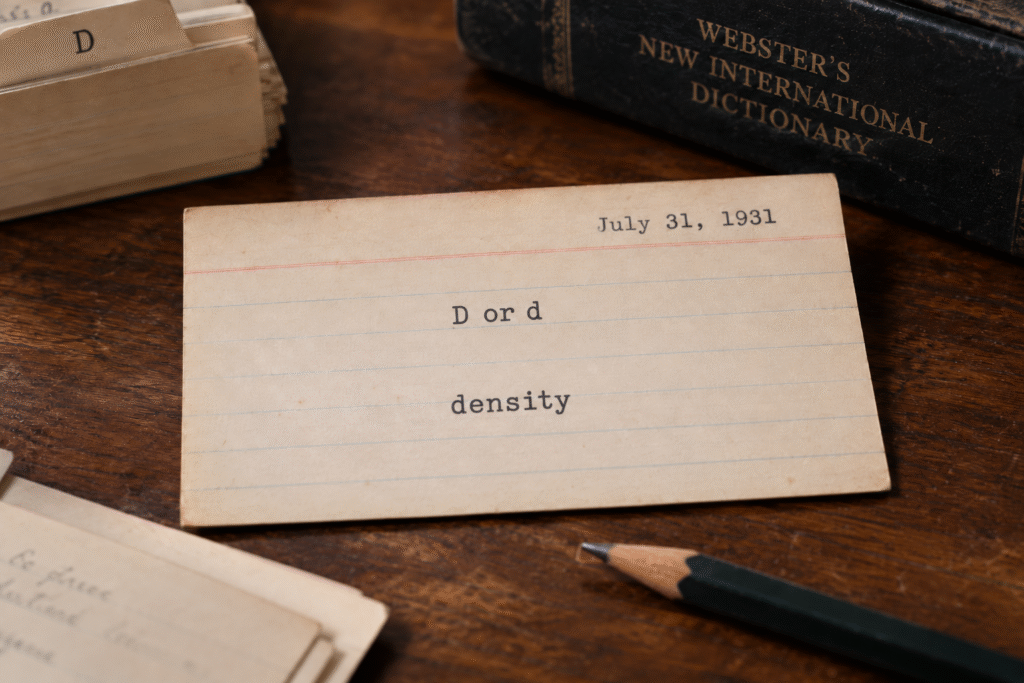
The editor had finally found the trail.
It did not appear to lead to dord.
There was no such word on the card.
Patterson’s intention was ordinary enough. Density could be abbreviated with an uppercase D or a lowercase d.
D or d.
That was what the card said.
The editor must have looked closely at it, because the markings on that little piece of paper contained the rest of the story.
Dictionary copy was prepared according to conventions that made perfect sense to the people using them and rather less sense several decades later. When a headword was prepared, its letters could be spaced apart so that pronunciation and stress marks might later be inserted.
A word such as:
word
might therefore appear in working copy as:
w o r d
Now Patterson’s note looked rather different.
D or d
The letters were all there.
D. O. R. D.
Only one space stood between an abbreviation and a word that had never existed.
The card had passed from Patterson to another part of the editorial process.
Who first saw D or d and read D o r d is no longer the important part. What matters is that the interpretation survived long enough for somebody to treat the four letters as a headword.
There are markings on the slip showing that the letters were to be set as one.
Dord now had a name.
The next editor did not receive Patterson’s original intention. That editor received a word.
Pronunciation was required.
A pronunciation was supplied.
Another little layer settled around it.
The definition was already waiting: density.
The subject belonged naturally to physics and chemistry.
By degrees, the accidental word began to resemble every genuine word around it.
I wondered what the page must have looked like by the time it reached the final stages of production.
Probably quite unremarkable.
That is what troubles me about it.
A proofreader eventually saw dord. So did other experienced dictionary people. Yet the peculiar little word had already acquired a respectable appearance. Someone had made it a headword. Someone had considered its pronunciation. The definition made sense. The scientific label made sense.
For the person examining the proof, there was no little card beside the entry saying, “You may wish to ask Austin Patterson what he meant by this.”
There was simply:
dord, n. Physics & Chem. Density.
I know what I would have done next, or at least what I usually do now when an unfamiliar technical word appears in a manuscript.
I would check it.
The difficulty in 1934 was that checking dord in Webster’s would produce a wonderfully reassuring answer.
Yes.
There it is.
Dord.
The dictionary had become its own alibi.
The editor in 1939 had now worked back far enough to see the mistake before it put on its respectable clothes.
The card explained the word. The absence of citations explained the missing history. There was no obscure branch of physics to investigate and no forgotten scientific usage waiting to be rediscovered.
There had only ever been D or d.
A correction slip was prepared.
Across it appeared two words that have survived as one of my favourite details in the story:
imperative! urgent!
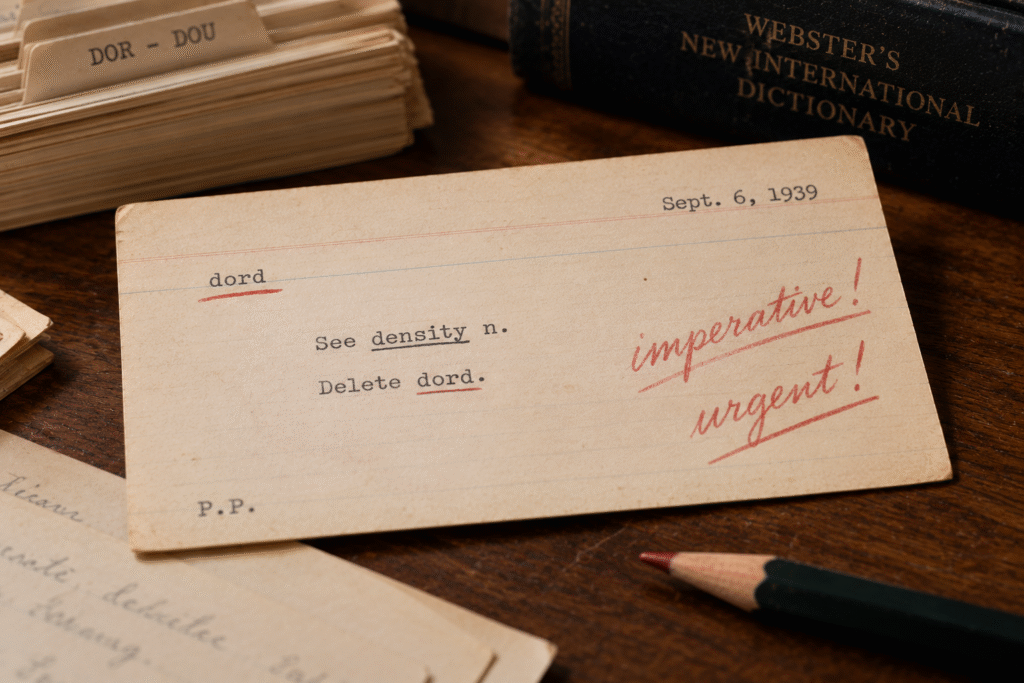
One can sense a certain impatience.
Dord had been discovered. The evidence was sitting in the files. The word was to be removed.
And yet, if this were a mystery novel, this would be the moment when someone looked at the empty doorway and realised the suspect had gone.
The next editions still carried dord.
The urgent instruction had not finished the job.
It remained in the dictionary while the calendar moved through 1940 and 1941. The United States entered a war. Europe changed beyond recognition. New words entered everyday speech.
Dord stayed where it was.
There is no satisfying explanation in the surviving record for the delay.
Printing offers part of the answer. This was a dictionary made with physical type and printing plates. A line could not simply be selected and deleted. Dord occupied space in a tightly constructed page, and removing that space meant rearranging what surrounded it.
Even so, the correction marked imperative! urgent! in 1939 was not finally reflected in the plates until 1947.
Sixteen years had passed since Patterson wrote his note about density.
For thirteen of them, the accidental word had occupied a place in Webster’s.
Then, at last, it was gone.
I had thought that would finish my afternoon with dord.
Instead, the word became rather harder to escape once it had been removed.
Lexicographers remembered it. Articles were written about it. The original slips survived. Merriam-Webster eventually told the story itself. There was even a name waiting for creatures of its kind.
A ghost word.
The term refers to a word that finds its way into dictionaries or other records through error despite lacking a real history of use.
Dord had finally acquired a category to which it genuinely belonged.
I looked again at the surviving image of Patterson’s card.
It is an unimpressive object.
There are no mysterious symbols on it. No frantic correction. Nothing scratched out or rewritten. Patterson appears to have written precisely what he intended to write.
D or d
density
The card then travelled through an organization devoted to making language precise, and somewhere during that journey somebody saw a word.
The mistake became more convincing with every hand it passed through.
Perhaps that was why I continued reading about it long after I knew how the mystery had been solved.
I had started with a word that possessed no past and followed it backwards until I reached a small card in 1931. The journey ought to have made dord disappear.
Instead it had given the word a history.
By the time I returned to the old dictionary, the afternoon was nearly over. Dord was still there in the entry, surrounded by legitimate words, looking as comfortable as it must have looked in 1934.
I closed the dictionary.
Then, after a moment, opened it again.
There was something oddly reassuring about finding dord exactly where I had left it.
A word that never existed had proved remarkably good at surviving.
Sources and further reading
- Merriam-Webster. “Dord”: How a Non-Word Made It into the Dictionary
- Merriam-Webster. How a Ghost Word Appeared in the Dictionary
- Philip Babcock Gove. The History of “Dord”
- Allen Walker Read. The Sources of Ghost Words in English
PPS Voices
Join the conversation
Comments are reviewed before publication. Please keep the discussion relevant and respectful.
No comments yet. You can be the first to join in.